
Water Damage Restoration near Paradise Valley AZ
Flow State Restoration provide water damage restoration for homeowners in Paradise Valley. The original plumbing, roofing, and irrigation systems are all at or past the point where things start going wrong. If you need help with water damage, call Jesse.
Common Water Damage Issues near Paradise Valley AZ
Paradise Valley homes are built on a scale that means water spreads quickly when something lets go. These are the issues we encounter most in this area.
Copper plumbing failures
Homes built in the late 70s and 80s in this area have a real mix of plumbing types. Some got the gray plastic pipe that was common in that era — which is well past its reliable service life. Others have original copper that has been dealing with Phoenix hard water for 40 years. Both fail in similar ways: slow pinhole leaks inside wall cavities that go undetected until the drywall shows a stain or bubbles. By that point the inside of the wall is usually worse than the exterior surface suggests.
Flat and tile roof leaks
In paradise valley, there is mix of flat roofs on older ranch homes and tile roofs on the larger homes. The flat roofs havent been touched in years and in the tile roofs the waterproofing layer beneath it is failing. We get a lot of ceiling leak calls from Paradise Valley after monsoon season every year.
Slab leaks from aging underground plumbing
The expansion and contraction cycle of Phoenix soil hits these slabs hard. 35 to 45 years of it adds up. The hot and cold water lines running under the slab develop stress fractures that start as a slow seep and eventually become a real problem.
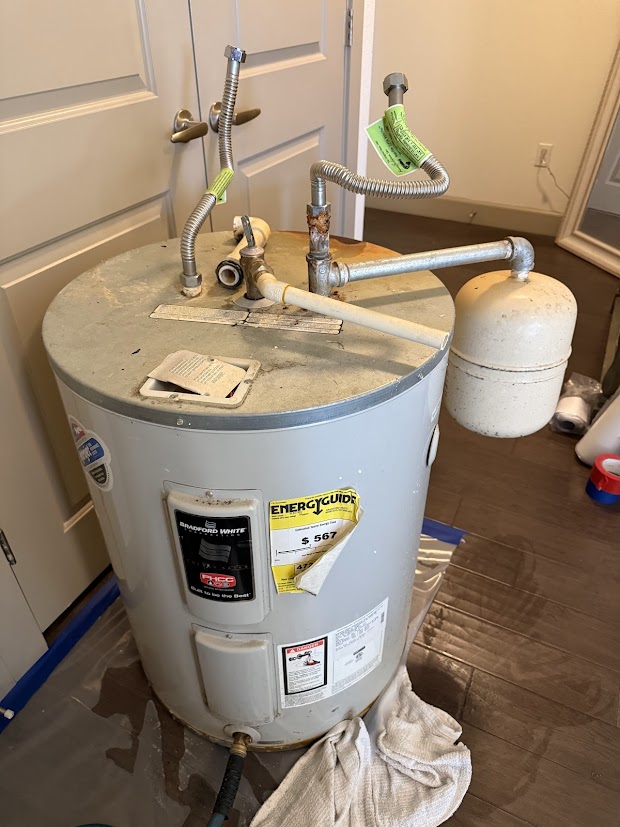
Water heater failures in interior closets and garages
A lot of Paradise Valley homes have the water heater in a utility closet inside the house rather than the garage. When a 40 or 50 gallon tank fails — and at 20 to 25 years old they fail — the water goes onto the interior floor with no drain and no way out. It saturates the closet floor, wicks into the adjacent walls, and spreads under the flooring into the hallway or living area. The visible damage on the surface is almost always smaller than the actual wet zone.
Irrigation and drainage around foundations
The area has deep-watering drip systems and irrigation timers that havent been adjusted in years — a lot of these homes are running more water against the foundation than the owners realize. When the emitters are close to the house and the system is running multiple times a week the soil against the slab edge stays perpetually damp. Over time that moisture works through the stucco and into the lower wall assembly. It is a slow process but in a home that has been sitting on the same irrigation schedule for 20 years the damage inside the wall can be significant by the time anyone notices.
How Water Damage Spreads near Paradise Valley in Phoenix AZ
The homes in this area are builds with good layouts but constructed in an era when moisture barriers and vapor protection were not what they are today.
Water gets into these homes and it moves — through the wall framing, across the subfloor, under multiple layers of flooring that have been added over the years.
HOAs in Paradise Valley vary widely — some have active exterior maintenance requirements, others are minimally managed. In communities with little
HOA oversight the individual homeowner is responsible for everything: roof, drainage, tree trimming near sewer lines. Some keep up with it, some dont. When they dont, water damage is usually what brings it to their attention.
Our Water Damage Restoration Approach
Paradise Valley homes need technicians who understand late 70s through early 90s construction — the plumbing materials used in that era, the roofing assemblies, and how these homes were laid out. We have worked enough jobs in this area to know what to look for.
We have IICRC Certified technicians and advanced equipment to handle any water damage restoration in Paradise Valley.
Evaluation
Moisture meters and thermal cameras are used by our technicians to map the full extent of the water damage. We check the wall cavities, flooring layers, ceiling leaks and along the slab edge for water damage issues.
Water Removal
Truck-mounted extraction for main living areas. Portable extractors for tight spaces, closets, bathrooms, and laundry rooms. For category 3 sewage or storm drain events we follow full IICRC S500 protocols — extraction, antimicrobial treatment, and removal of all porous materials that contacted the water. Drying
Drying
Commercial air movers and dehumidifiers throughout. We monitor daily and adjust equipment placement based on what the readings tell us — not a fixed schedule. Average drying runs 3 to 5 days for standard events, longer for slab leaks that have been running and for multi-layer floor situations.
Repair & Remodeling
We handle all types of remodeling – flooring, painting, baseboard and trim, and coordination with plumbers for pipe repairs. Paradise Valley homeowners have put real money into updating these older homes — upgraded kitchens, tile work, custom baths. We match existing finishes carefully so the repaired area blends.
Serving Homes Near Paradise Valley Phoenix AZ
We provide water damage restoration in Phoenix AZ – Along Tatum Boulevard between Shea and Bell Road. Near Scottsdale Road and Greenway. Other close by neighborhoods we also serve — Homes near Paradise Valley Mall at Cactus and Tatum. Properties along 40th Street near Thunderbird Road. The Kierland area near Scottsdale and Greenway. Homes near the Indian Bend Wash corridor. Communities along Cave Creek Road south of Bell Road.
Frequently Asked Questions About Water Damage Restoration Near Paradise Valley, Phoenix AZ
I noticed a spot on my floor near the hallway. Is it a slab leak?
A warm spot on a tile floor in a home this age is a slab leak until proven otherwise. Hot water lines running under the slab develop stress fractures from decades of expansion and contraction. The water is slowly heating the concrete above it which transfers as warmth to the tile surface. You can have a significant amount of water moving under that slab before it ever surfaces anywhere visible. We can do a thermal scan to locate the temperature differential and tell you where the leak is without tearing up any floor first.
We had a toilet overflow when we were not in the house for a week. What can i do now?
A week-long overflow in an unoccupied house is about as bad as residential water damage gets. Depending on whether the toilet ran continuously or flooded and stopped there could be water through the bathroom floor, into the subfloor, through adjacent walls, and possibly into lower areas of the home if the bathroom is on a raised section. The standing time also means mold is almost certainly already started. We need to get in and assess the full extent immediately — the longer it sits the worse the mold situation becomes and the more structural material has to come out.
Our backyard drip irrigation has been on the same timer for 15 years and I think I have water coming into the back bedroom wall near the floor. Could this be related?
Irrigation emitters running close to the back wall for years with no adjustment puts a continuous stream of moisture against the foundation. The soil against the stucco stays wet between watering cycles. Eventually that moisture finds a way through. The lower section of a back bedroom or family room wall is exactly where it would show up. We can moisture-test the wall from the inside to confirm and check the extent. Fixing the irrigation schedule helps going forward but doesnt dry out what is already in the wall — that needs proper equipment and time to do right.
Need Water Damage Restoration Near Paradise Valley Phoenix AZ?
Flow State Restoration handles everything from emergency water extraction to complete restoration near Paradise Valley while working directly with your insurance company to maximize coverage.