
Flood Cleanup Near the Gilbert and Chandler Border
Our team handles emergency water damage, fire damage cleanup, and mold remediation with rapid response, advanced drying equipment, and proven restoration methods to protect your property and prevent further damage.
What’s Covered on This Page
- Flood Cleanup for Homes Along the Gilbert-Chandler Border Area
- How Our Team Reaches the Gilbert and Chandler Border Area from Our Gilbert Location
- What Early-2000s Construction Means for Water Damage in This Corridor
- Why do homes along the Gilbert-Chandler border flood differently than other parts of Gilbert?
- How quickly can your team reach neighborhoods near the Gilbert-Chandler border after a monsoon storm?
- What should border-area homeowners check after a storm even if the floor looks dry?
Flood Cleanup for Homes Along the Gilbert-Chandler Border Area
A hard monsoon cell can sit right over the Gilbert-Chandler border for twenty minutes and dump enough rain to overwhelm every storm drain along Chandler Heights Road. We’ve pulled soaked carpet out of homes in that stretch more times than we can count. Flood cleanup near Gilbert and Chandler border is steady work for us, especially July through September.
The neighborhoods right along that line have a specific problem. Many of the subdivisions south of Pecos Road and east of Arizona Avenue sit on flat desert grading. Water does not always have a clear path away from your foundation. It pools against block walls, creeps into garages, and finds its way under door thresholds before you even realize the storm’s that bad.
And once it’s inside, things move fast.
Desert soil does not absorb water the way people expect. Hardpan clay under the top layer pushes runoff sideways, right toward your slab. Homes in this border zone deal with this all the time during active monsoon weeks. We see water intrusion through:
- Garage-to-house transitions where the slab slopes slightly inward
- Sliding glass doors along back patios with worn or missing weather seals
- Stucco cracks near the foundation line that let moisture wick into drywall
- AC condensate lines that back up during high-humidity storms
Most homeowners near the border do not realize the damage is already inside the wall. You mop the floor. You run a fan. You think you’re fine. But moisture trapped behind baseboards or under laminate flooring starts breaking things down within 48 hours. That’s when mold gets a foothold, the subfloor warps, and a small cleanup turns into a bigger project. (We see that after a lot of July storms.)
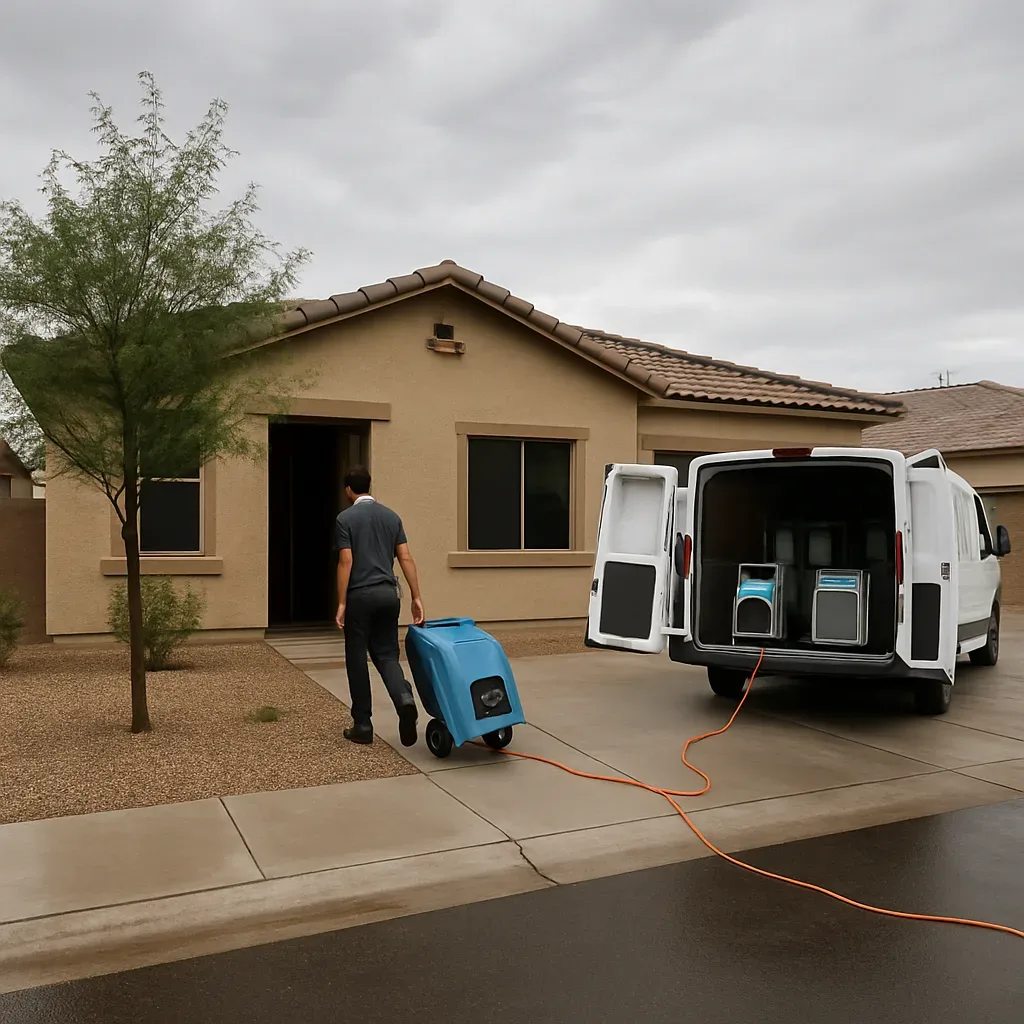
We handle flood cleanup differently here than we would in older parts of town. The homes along corridors like McQueen Road south of Chandler Heights tend to be single-story builds from the late ’90s and 2000s. Slab-on-grade construction with stucco exteriors. That means no basement to worry about. It also means water has nowhere to go but sideways through your walls. We focus on structural drying early, getting air movers and dehumidifiers placed within hours so the moisture does not settle in.
One thing we run into a lot in this area is homeowners who had a “small” flood two storms ago and never fully dried the space. They call us for the second event. We pull back the baseboards, and there’s already discoloration spreading. That first flood did more than they thought. So we always check beyond the visible waterline.
But here’s the good news. Flood cleanup done right and done fast saves most of what’s in your home. Your tile holds up fine. Your cabinets usually survive if we get airflow behind them quickly. The drywall below two feet might need replacing. That’s common with border-area flooding where water enters low and stays low.
We’re out in these neighborhoods every monsoon season. The streets between Gilbert and Chandler blur together for a lot of people, but exactly which subdivisions flood first and where the drainage weak spots are. That matters when you’re standing in two inches of water at 10 p.m. on a Tuesday wondering what to do next.
How Our Team Reaches the Gilbert and Chandler Border Area from Our Gilbert Location
Our shop sits at 1733 E Aspen Way in Gilbert. That puts us just a short drive north of the border area, and that matters when your living room carpet is soaking wet at 2 a.m.
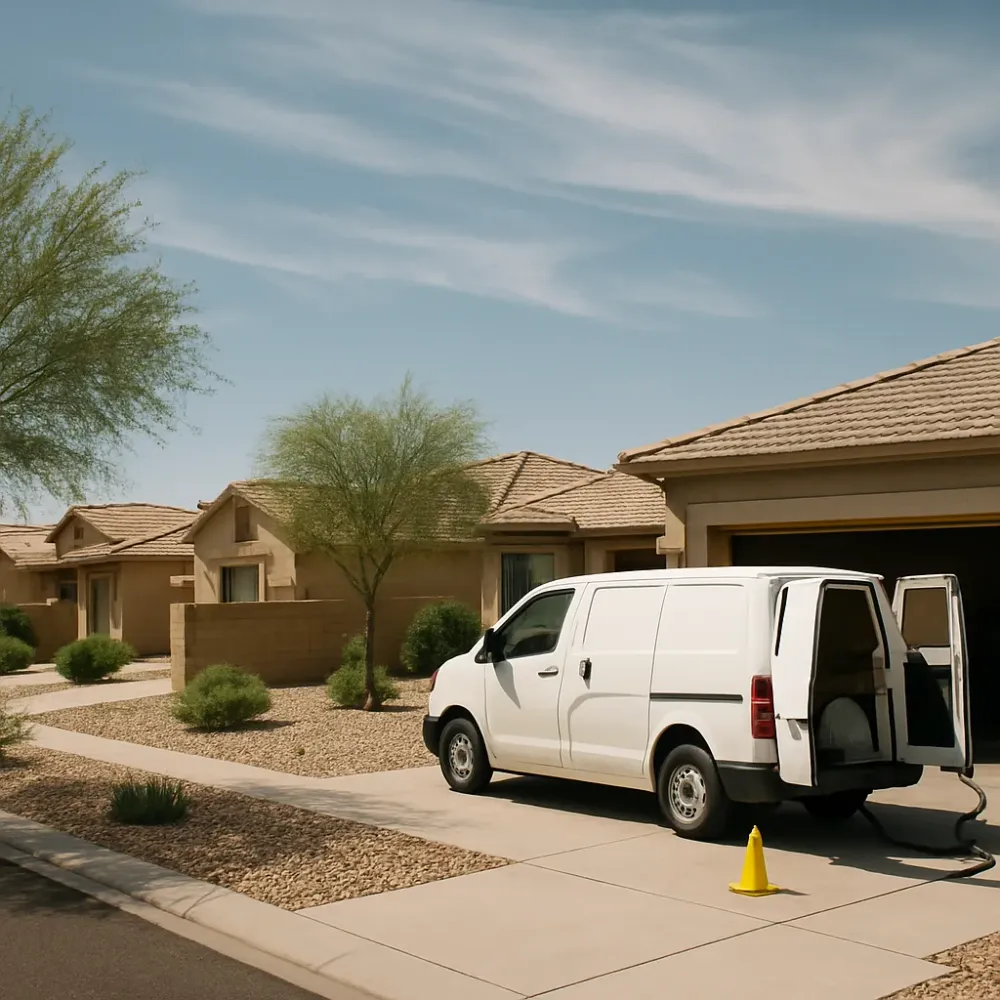
Here’s the route we take almost every time:
- Head south on Lindsay Road from E Aspen Way.
- Continue past the Santan Freeway interchange where Lindsay crosses the 202.
- Stay on Lindsay until we hit the neighborhoods south of Pecos Road, where Gilbert starts blending into Chandler near the boundary zone.
- From there we cut east or west depending on which street you’re on. If you’re closer to Val Vista, we swing over on Chandler Heights. If you’re near Cooper Road, we drop down through the Spectrum area.
Most runs take about 12 to 15 minutes with normal traffic. During morning rush on Lindsay, add five minutes. But at night when flood cleanup calls tend to come in, the roads are empty and we’re pulling up fast.
the grid down here well. The streets south of Pecos and east of Arizona Avenue have a rhythm to them, big residential blocks broken up by small parks and school zones. And once we’re past the 202, the route is a straight shot with almost no turns. That predictability helps when we’re loading a truck with extraction equipment and structural drying gear at odd hours.
One thing about this stretch of the East Valley is that street names can shift right at the boundary line. A road you think continues into Chandler might jog or change names. We’ve done enough flood cleanup calls down here that we do not rely on GPS alone anymore. which cul-de-sacs loop back and which neighborhoods only have one way in off the main arterials.
If you’re near the Mesquite Groves Aquatic Center or the neighborhoods tucked behind Power Road south of Pecos, we can reach you without ever touching a freeway. Surface streets the whole way. That keeps our arrival time steady even during monsoon season when highway on-ramps flood and traffic backs up around the 202 interchanges.
And if you’d rather come to us, it’s the same route in reverse. Head north on Lindsay or Val Vista, cross over the 202, and we’re just a few blocks east of Lindsay near Guadalupe Road. But for flood cleanup you do not want to come to us. You want us at your door with fans and extractors ready to go.
The border area keeps us busy during July and August storms. Water pools fast in the neighborhoods south of Pecos because the drainage infrastructure shifts between Gilbert’s system and Chandler’s system right in that zone. So we’ve learned to stage equipment ahead of big storm forecasts, keeping a truck ready to roll south the moment calls start coming in.
Short drive. Familiar streets. No guesswork on how to find your house in the dark during a downpour.
What Early-2000s Construction Means for Water Damage in This Corridor
A lot of the homes along the Gilbert-Chandler border went up fast. Really fast. The early 2000s housing boom pushed builders to finish subdivisions in months, not years. That speed left marks you can’t always see from the curb.
We do flood cleanup in this corridor all the time, and the construction patterns tell a story. Homes built between roughly 2000 and 2006 along streets like McQueen, Cooper, and the neighborhoods branching off Chandler Heights share a few traits that matter when water gets inside.
Here’s what we see most often in early-2000s builds in this part of Gilbert:
- Slab-on-grade foundations with minimal slope away from the home, so rainwater pools against the foundation instead of draining
- OSB (oriented strand board) used in subfloors and sheathing instead of plywood, which swells and crumbles faster when wet
- Paper-faced drywall throughout, including garages and laundry rooms where moisture exposure is highest
- Polybutylene or early PEX plumbing transitions that develop pinhole leaks after 15 to 20 years
None of that makes these bad homes. They’re solid houses. But when a monsoon pushes water under a garage door or a supply line bursts behind a bathroom wall, the damage moves quicker than it would in older block construction.
OSB is the big one. It soaks up water like a sponge. Then it does not dry out the same way plywood does. We’ve pulled up carpet in homes off Riggs Road and found subfloor material that looked fine on top but was soft and swollen underneath. That’s a flood cleanup problem tied to this era of building. You cannot just extract the surface water and call it done.
And the slab foundations here sit on desert clay soil. Clay expands when it’s wet. After a heavy rain event in this corridor, that expansion can push moisture up through hairline cracks you did not even know existed. We’ve seen baseboards buckle in living rooms where nobody spilled a drop. The water came from below.
The plumbing issue is catching up to this area right now. Homes built in 2002 or 2003 are hitting that 20-year mark where fittings corrode. A slow leak behind a wall can run for weeks before you notice the musty smell. By then, mold inspection and testing becomes part of the conversation too. By the way, that smell near the laundry room is often the first clue.
So what does all this mean for you if you live in one of these subdivisions? It means flood cleanup here is not just about removing standing water. Structural drying has to go deeper. We pull baseboards. We check behind cabinets. We use moisture meters on subfloor material because the surface can lie to you.
Most homeowners in this corridor do not realize the damage is already inside the wall by the time they see a stain on the ceiling or feel soft spots in the floor. That is not their fault. These homes were built to look good. They just were not built for the kind of water events the East Valley throws at them every July and August.
But knowing your home’s age gives you a head start. If your place went up during that Gilbert-area building boom of the early 2000s, you already know what to watch for now.
Frequently Asked Questions
Common questions about flood cleanup near gilbert and chandler border services in AZ
Why do homes along the Gilbert-Chandler border flood differently than other parts of Gilbert?
The flat desert grading south of Pecos Road is the main reason. Hardpan clay just below the surface pushes runoff sideways instead of letting it soak in. That means water moves toward your foundation fast. In border-area subdivisions, it pools against block walls and slips under garage thresholds before most storms even finish. You may not see it coming until it’s already inside.
How quickly can your team reach neighborhoods near the Gilbert-Chandler border after a monsoon storm?
Most runs from our Gilbert location take about 12 to 15 minutes. We head south on Lindsay Road past the 202, then cut east or west depending on your street. At night, when most flood calls come in, the roads are clear and we move fast. We know which cul-de-sacs loop back and which neighborhoods only have one way in, so we are not slowing down to figure out the route.
What should border-area homeowners check after a storm even if the floor looks dry?
Check behind your baseboards and under any laminate flooring near sliding glass doors or garage transitions. Homes in this zone often have moisture trapped inside walls before the floor even feels wet. Desert soil pushes water sideways into slabs and stucco. If you had any flooding in the past two monsoon seasons, there may already be discoloration spreading inside the wall that you have not seen yet.
Ready to Get Started?
Call now. Call +1-480-956-3500 today.